 DigitalHive DigitalHive
We create augmented reality, virtual reality and mixed reality experiences that help brands explain products, bring ideas to life and give people new ways to interact with physical and digital spaces.
We create augmented reality, virtual reality and mixed reality experiences that help brands explain products, bring ideas to life and give people new ways to interact with physical and digital spaces.
Sometimes a website, video or physical display is not enough to explain an idea or hold someone’s attention. We use immersive technology when there is a clear reason for people to see, explore or interact with something differently.
Your Product Is Difficult to Explain
Customers Need to Visualise Something Before Making a Decision
The Real Environment Is Difficult to Visit
Your Event Needs More Than Screens and Printed Displays
Training in the Real World Is Costly or Difficult
You Want People to Interact With the Brand, Not Just See It
You Need to Connect a Physical Space With Digital Content
You Have an Idea but Do Not Know Which Technology Fits
Some products, systems or ideas are easier to understand when people can explore them for themselves. We create interactive experiences that make complex information easier to see and understand.
A customer may want to see how a product looks in a room, on themselves or in a real environment before buying. Augmented reality applications can help bring that experience closer to the real thing.
A property, destination, showroom or facility may not always be easy to access. Virtual experiences can give people a way to explore it from somewhere else.
Trade shows, launches and activations are crowded environments. We create augmented reality events and immersive experiences that give visitors something to participate in rather than simply walk past.
Some situations are difficult, expensive or unsafe to repeat for training. Virtual environments can give people a controlled place to practise and learn.
Immersive experiences can turn a campaign, product launch or physical space into something people actively take part in.
AR and mixed reality can add information, storytelling or interactive elements to products, packaging, exhibitions, retail spaces and other real-world environments.
You do not need to decide whether the answer is AR, VR or MR before speaking to us. We start with what the experience needs to achieve, then choose the technology that makes sense.
We work from the idea outward. The technology comes after we understand what people need to see, do or understand.
We create AR experiences that add digital content to the real world through phones, tablets and compatible devices. This can include product visualisation, interactive campaigns, event experiences and digital layers added to physical spaces.
We build virtual environments that people can enter and explore using a headset. VR can be used for virtual tours, product experiences, training, simulation, storytelling and events.
Mixed reality places digital objects inside the physical environment and allows people to interact with both at the same time. It can be useful for demonstrations, learning, design and experiences where digital content needs to respond to the space around it.
We create experiences for launches, exhibitions, activations and branded environments where participation is part of the idea. This can include AR, VR, interactive 3D or a combination of technologies.
We help brands present products, spaces and environments in ways that people can explore digitally, whether through a virtual showroom, interactive product experience or guided walkthrough.
Immersive projects often need custom 3D objects, environments, animation and interaction. We create the digital content needed to make the experience work across AR, VR and mixed reality.
The process starts with the audience and the purpose of the experience, not with choosing a headset or technology.
We start with what you want people to experience, learn or do, who the audience is and where the experience will be used.
We decide whether AR, VR, MR or another interactive format is the right fit based on the environment, audience and level of interaction needed.
We map the user journey, what people will see, what they can interact with and how they move through the experience.
We create the visual content, 3D elements, interfaces and interactions, then develop the experience for the required device or platform.
Immersive experiences need to work where people will actually use them. We test the interaction, devices and performance before launch.
Once the experience is live, we can review how people interact with it and identify where the experience can be improved or expanded.
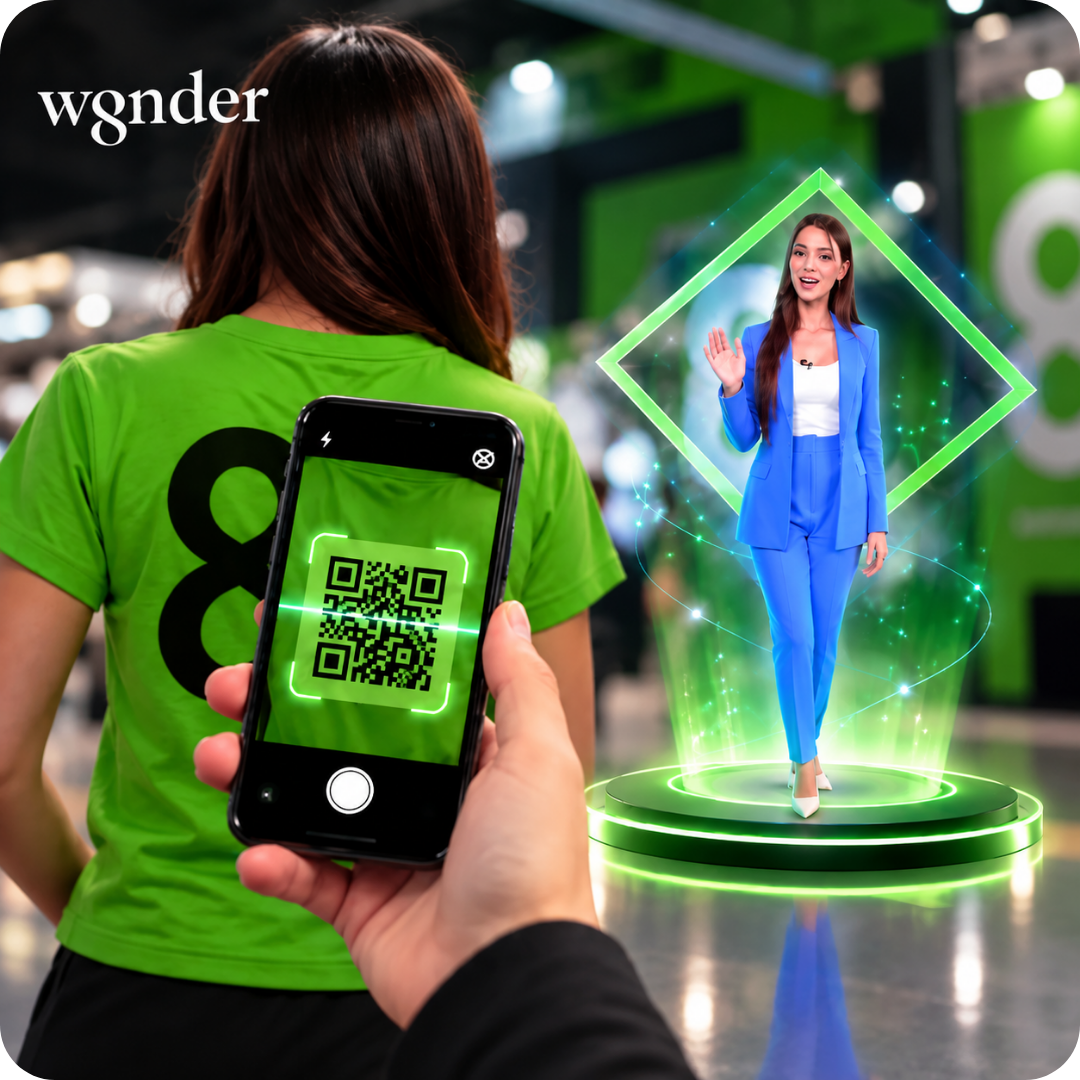
For WonderEight at Gulfood Green Expo 2024, we created a mobile AR activation that visitors could access by scanning QR codes worn by promoters across the event. The experience replaced the need for a traditional booth while still giving people a simple, interactive way to engage with the brand and its sustainability message.
When comparing augmented reality vs virtual reality, the main difference is how much of the real world you still see. AR adds digital content to your surroundings, while VR places you inside a fully digital environment. AR is usually experienced through a phone, tablet or wearable, while VR normally uses a headset.
Mixed reality combines digital content with the physical environment in a way that allows both to interact. For example, a digital object could appear to stay on a real table as the user moves around it.
XR stands for extended reality. It is the wider term used to cover augmented reality, virtual reality and mixed reality.
We create virtual reality in Dubai for experiences such as virtual showrooms, training, simulations, events, product demonstrations and interactive virtual environments. The format depends on what people need to experience and where it will be used.
These technologies can be used across retail, real estate, hospitality, events, education, training, manufacturing, tourism and other industries where people benefit from seeing, exploring or interacting with something in a different way.
Start with the outcome rather than the technology. We look at the audience, environment, content and type of interaction needed, then recommend the format that fits the project best.